Q: Thanks to taking the time to talk with me. Could you briefly introduce yourself and what you do?
I work at One Medical Group, which is a national primary care provider. We have over 50 offices in 7 markets across the US. We are a primary care office , and we own both our tech systems and our physical doctor’s offices as well – so the doctor you see is employed by the same company that employs me as a data scientist. I work behind the scenes analyzing both operational and clinical data to make things more efficient, to allow for our providers to make better decisions, and to help our business run as well as it can. Another component is trying to build more intelligent systems that can adapt and personalize to our patients needs. We have a fairly small data team, so I’ve worked on things from our clinical data, to marketing data, to operations data – a lot of odds and ends. Since we are a vertically integrated company I get to see how everything relates to each other, and I get a high level view of how what one team does affects another team in ways that can be unforeseen.
Q: Could you give me some background on your data science education?
At NYU, I was in a specific college called Gallatin where no one has a major – you just make it up. I loved it, but it’s not for everyone. One of the things going into college that I was very interested in was artificial intelligence and everything it touches. I was interested in it not just from a purely theoretical perspective, or from a sociological perspective – but also a technical perspective. So one of the cool things was that I got to study them all, put them all together, and take classes without any prerequisites.
Although my education is relevant, it’s not directly relevant to what I do now. But because the program is something that you make up by yourself, you constantly have to explain yourself, you have to bring people along, and you have to be able to draw a narrative thread between classes that don’t really seem like they fit together – which is a valuable skill for data science. Having to explain the narrative – I know this is a data science cliche, is truly one of the most important skills in data science. No matter how many algorithms you know or how many analyses you can do, if no one understands on some rudimentary or conceptual level what you’re doing or why you’re doing it, it’s just going to sit in a corner by itself rather than moving people to action.
Q: How did you get a job as a data scientist?
The way that I came into data science is through machine learning. I took a bunch of classes related to it, and NYU has a couple of large research groups regarding machine learning. I really got into it in college and that was the thing I wanted to do coming out of college, so that’s what I did.
I’m going to put data science into two somewhat arbitrary bins: doing analysis versus building models. When I started doing, I was purely doing models, but over time I’ve gravitated more towards the middle. I think while machine learning is an awesome tool, it’s also not the right tool for every case. Over time I’ve tried to make sure that I use or leverage machine learning in places where it’s going to be useful and where it won’t be overwhelmingly costly to run on an ongoing basis. I’m trying to be more judicious as to where I use machine learning and what techniques I use. Lastly, I’m learning more statistics, and trying to be more focused on analysis than I previously was.

Q: What strategy for learning data science skills was most successful for you?
I’d say finding good mentors. I have a number of awesome mentors that I feel I can lean on for a number of different things. Not all of which are data scientists, and not all of which are programmers, per se – but they are people who I can lean on for advice on how to communicate things, and how to explain myself in a way that makes sense. Of all the data science skills, that’s where I was the most deficient when I first started, and having those mentors there to guide me along has been huge.
Get To Know Other Data Science Students

Diana Xie
Machine Learning Engineer at IQVIA

Ginny Zhu
Data Science Intern at Novartis
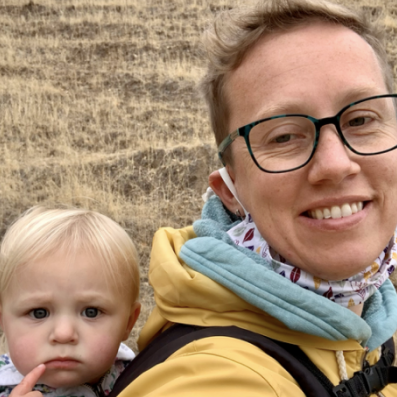
Meghan Thomason
Data Scientist at Spin
Q: What does your workflow look like?
It depends on the cycle that I’m in. I tend to break it down into 3 different sections – the section where I talk to people, the section where I don’t talk to people, and the section where I talk to people again. The first section is mostly fact finding – understanding the needs of the problems we are trying to solve, what we want to know, what the open questions are. I try to get as many people in the room with me as possible to agree with me on the problems we want to solve with our deep dive analysis. Once I have a pretty clear picture of what everyone wants, and I’ve aligned with everyone in terms of what they expect as the result, I tend to go into a phase of deep analysis. One of the hard things about data science is that you want to leave it open-ended for exploration, but you can’t just go in a room for a month without telling [your company] what you’re doing. So setting expectations at that point is super important.
Analysis generally takes place within the timespan of a week, depending on how big the questions are. It can also be within the timespan of a day, depending on what team I’m working on and how fast they need the answers. During the middle phase I block off significant chunks of uninterrupted time to go heads down, find the right data, validate what I’m seeing, and to make sure what I’m reporting is statistically significant.
Q: Do you have an example of a problem you have worked on like this?
One example that is pretty common is retention. There are a lot of different factors that go into retention: how people use their apps, how intrinsically valuable people feel your services are, how often they interact with you through it, and what kind of services do you provide.
There are lot of dimensions from which we look at retention – we look at it from a purely consumer perspective, from the impact of our ability to manage population health, from the business-to-business perspective. There are a number of different cycles where it would start with us focusing on one very specific question. I typically like to focus on one large abstract question, and that can be the most broad and general of questions. A question that can go on the top of the presentation so that everyone can be aware of what’s going on – a North Star that we can align with. If everyone can agree that knowing the answer to that question would be valuable, you don’t have to explain why you are doing the analysis.
Generally you want a question that people have already been asking themselves. It certainly should be a proxy to a common business question that people want an answer to. And sometimes, if you’re working with a product team, no one knows to be asking that question yet. If that’s the case – it allows you to work as a team to really evangelize why you should be asking this question in the first place.
Q: Do you have any favorite tools and/or coding languages?
My favorite language is Python – you can write just about anything in it in a way that is easy, and there’s a framework for everything. In some respect it supports both procedure and programming, which is pretty handy because sometimes things don’t fit into one paradigm or another. We also use Tableau here, quite heavily. I think it’s a totally awesome tool for sharing data and disseminating data across an organization.
One of the tools which I’ve recently become a big fan of is using the Google Suite or Dropbox Suite for interactive documents. It’s my new favorite method of disseminating analysis that is not being presented in a very formal context. The reason why is that it makes collaboration really easy, and people tend to look at a powerpoint and a document differently, even if the quality of the information is the same. If we look at analysis as mementos, we can look back at years later to understand “why did we do that or what did we discover in that thing?” I’m actually a bigger fan of using a paper format rather than a presentation format. It’s easier to consume, you can write more information, and collaboration is easier.

Q: What are employers looking for when they are hiring a data scientist?
It tends to vary from company to company. One thing I tell people that is that data science means something different to just about every company. Even the most qualified people, and the people who really can do it all, will not be the perfect fit for every position and will not get hired for every position. One of the things I always recommend for people looking for a data science position is: Look for a position that does the type of data science work that you are interested in doing and learning. Generally the positions tend to fall to either the applied-engineering side or a statistics and analytics side. The types of interviews you will have in each will be wildly different. I’ve had coding challenges in my interviews in the past, and others where there were presentations I’ve had to give, and those are very different interviews. I’d say look at the type of job and title, and see where that falls on the spectrum between analyst and engineer to give you a sense of what to prepare for.
Data science is causing a significant shift in our daily lives. Simultaneously, credit must be given to all of the data scientists, machine learning engineers, and deep learning researchers that work around the clock to improve our lives.
Patrick is a mentor at Springboard for the Foundations of Data Science and Data Analytics for Business workshops.
Since you’re here…
Thinking about a career in data science? Enroll in our Data Science Bootcamp, and we’ll get you hired in 6 months. If you’re just getting started, take a peek at our foundational Data Science Course, and don’t forget to peep our student reviews. The data’s on our side.